
Upper Big Branch: Seven Days of Service
April 5–12, 2010 • Raleigh County, West Virginia
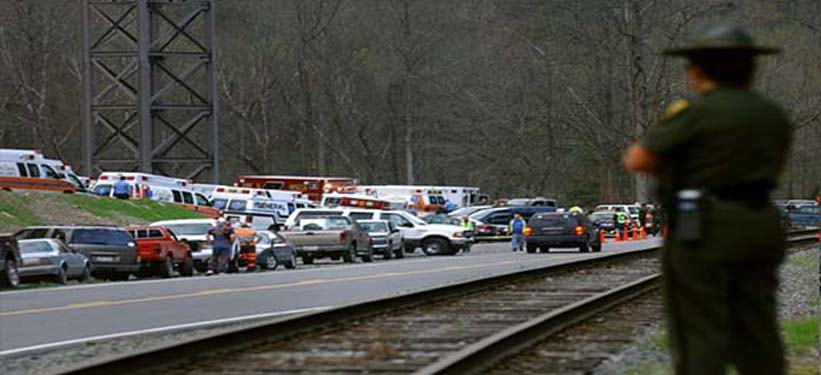
The Upper Big Branch Mine disaster occurred on April 5, 2010, roughly 1,000 feet underground in a remote corner of Raleigh County, West Virginia. Twenty-nine of the thirty-one miners underground at the time of the explosion were killed. It was the deadliest U.S. mine disaster since 1970.
Emergency crews gathered at one of the mine portals where it was initially reported that twenty-five miners had been killed and four remained unaccounted for. Two rescue chambers inside the mine offered hope that the missing miners might still be found alive. Over the next four days, rescue operations continued despite dangerous methane levels, smoke, and the extreme difficulty of operating underground. The entire rescue and recovery operation ultimately extended for seven days.
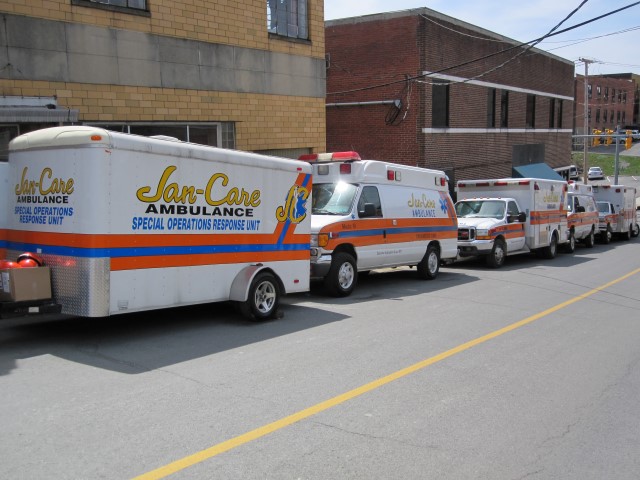
Jan-Care Ambulance's responsibilities included mass-casualty incident command, direct support of mine-rescue teams arriving from multiple states, ambulance staging for the possible mass retrieval of miners, and continuous medical support for the hundreds of family members gathered at the on-site Upper Big Branch Family Center.
Initial MCI Response — April 5, 2010

Jan-Care's initial missions included joint medical command within the mass-casualty incident structure, direct medical and rehabilitation support for multi-state mine-rescue teams, ambulance staging for the possible retrieval of large numbers of miners, and continuous support for family members at the UBB Family Center.
At the same time, the Incident Command System and mass-casualty response plan were fully activated. A five-person support team worked from the Jan-Care Command Center coordinating additional resources, backfilling existing EMS stations, maintaining 911 coverage in Jan-Care's home counties, and fully implementing a multi-county mutual-aid backup plan.
The remote location of the mine added another challenge. Radio and cellular communications were limited, complicating coordination among command staff, field crews, mine-rescue personnel, and outside agencies.
Continuous Support — April 6–12, 2010
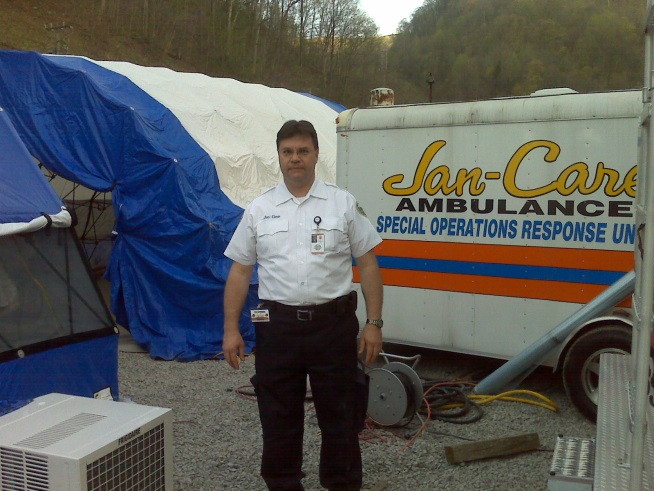
As the operation continued, the outcome remained uncertain. While twenty-nine miners were eventually recovered from the mine, the first several days were still treated as an active rescue operation. Jan-Care's EMS support therefore remained focused on both rescue-team operations and family support throughout the week.
Crews rotated through the site while the Jan-Care Command Center continued coordinating system-wide coverage. The company had to sustain a major incident response without abandoning the everyday emergency calls and patient transports taking place across its normal service area.
A Community Changed
The Upper Big Branch Mine explosion personally and deeply touched the Jan-Care organization. Many of the responders, families, and communities affected by the disaster were part of the same region Jan-Care personnel served every day.
The operation reinforced an existing commitment within Jan-Care: to maintain the personnel, equipment, communications, command structure, and mutual-aid relationships necessary to stand ready when a community faces an extraordinary event.
Upper Big Branch further strengthened Jan-Care's resolve to always stand ready to support our communities in times of need.